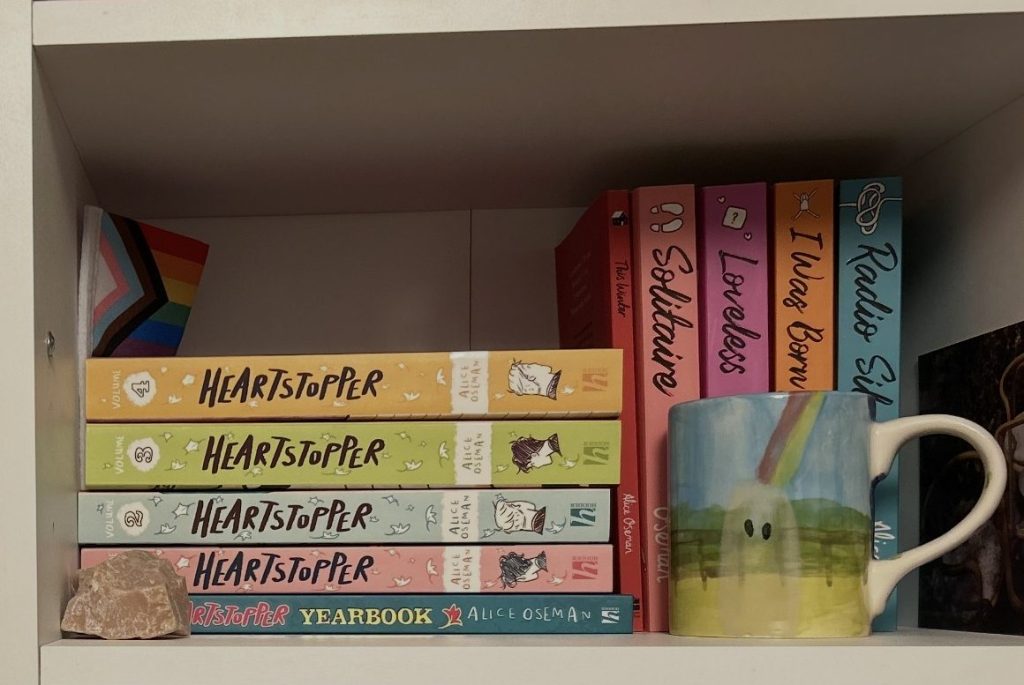
How a great book can inspire a lifelong passion for storytelling.
Heartstopper is a YA romance graphic novel series by Alice Oseman. The series follows Charlie, an openly gay teenage boy who struggles with his mental health, and Nick, a teenage boy who is coming to terms with the realisation that he is bisexual, as they navigate teenage love together.
These books also inspired a love for graphic novels in me. The ability to tell a story, not only in words but also visually, was extremely exciting to me as an artist. Especially after finding out that both aspects were done by Oseman. The illustrations add so much depth to the storytelling for me, and have such a clear way of showing the characters’ emotions.
Oseman’s writing shows how what can feel like a small community of readers can grow massively and unexpectedly. Heartstopper began as a webcomic on Tumblr and Tapas, which gained an enormous online fanbase. She crowd-funded a limited print-run edition, meeting their funding goal in less than two hours, and eventually became a best-selling book stocked in every book shop.
To me, these books are beautiful and rich in such a variety of representation. Representation is extremely important to me for many reasons, particularly in YA fiction, as we all look for characters that we can find ourselves in. It can provide immense comfort to someone living the same experience or facing similar struggles. When done right, realistic portrayals can help to educate readers on experiences different to their own, leading to empathy and understanding.
Minority groups are less likely to see their experience accurately portrayed in fiction and on screen. As a queer disabled woman, when I have read about someone who lives a similar life to me, it has made me feel much less alone. Heartstopper was the first book to do this for me.
The characters feel so real. We see their struggles, but not in a way that they suffer just to further the plot, but as a raw, messy look at what many teenagers struggle with. From Nick’s internal conflict with his sexuality, to Charlie’s struggle with Anorexia, OCD, and self-harm, to Elle’s experience as a transgender woman, to Tao’s parental loss, to Tori navigating her asexuality. There is such a wide variety of representation in these books that I and many people I know have found safety in.
And while including such a range of deep and complex topics, they are not the sole focus of the story. The story is still mainly light-hearted and centred around love and friendship, without minimising the issues that the characters have. Alice Oseman’s writing is a prime example of representation done right.
After reading these books, it prompted me to explore many more books with queer main characters and disabled main characters. And now, this is exactly what I want to write. I want to give young readers the same comfort that I found in Charlie Spring and Nick Nelson.
Thanks for reading! Follow my social media for more content!
Instagram: @written.by.caitlin
TikTok: @writtenbycaitlin


Leave a comment